
G-MANTIS Opinion: Strive to Uphold Oriental Heritage
G-MANTIS has long strived to break the inherent mindset of traditional factory operators and consistently observes and judges the development trends of China's packaging material manufacturing from a global perspective. Through in-depth overseas field research, participation in international exhibitions, connections with global industry associations, and extensive dialogues with cross-border procurement professionals, we have uncovered an essential industry truth. The hierarchical gap within the global self-adhesive and paper material industry appears to stem from hardware differences in equipment, formulas and craftsmanship. Fundamentally, it is a generational gap in innovative thinking, value systems and industrial discourse power.

The global industrial landscape is highly entrenched. European, American and Japanese brands dominate the mid-to-high-end material sectors and control core technical systems and international pricing power. In contrast, the vast majority of Chinese manufacturers remain trapped in a passive, copy-and-follow mindset. Massive overseas market verifications prove that the core weakness of Chinese materials does not lie in insufficient manufacturing precision or production capacity. Instead, the industry has long lacked the capability of original innovation and independent product definition.
Domestic manufacturers have for decades blindly adopted Western material application logic and replicated mature overseas product systems, leading to severe homogenization across the industry. Global competition has been narrowed down to mere price rivalry, leaving Chinese products with distinctive shortcomings: unique product characteristics are absent, brand recognition is weak, and irreplaceable competitive advantages are non-existent. This predicament has locked the entire industry in endless, low-value involution.
From G-MANTIS's industrial perspective, hardware imitation and technological benchmarking can only help manufacturers catch up with existing industry standards. Only cognitive upgrading, value restructuring and original innovation can deliver true industrial overtaking and dimensional breakthroughs. While the industry generally adheres to the conservative strategy of “following industry giants for stability”, it overlooks China’s unique indigenous industrial advantages. As the birthplace of papermaking civilization, China boasts thousands of years of accumulated material aesthetics. The flexible texture of bamboo fiber, the lightweight permeability of rice paper, and the gentle oriental material temperament are cultural and industrial assets that Western standardized industrial systems cannot replicate or emulate.
Throughout the decades-long iteration of global paper and self-adhesive materials, product upgrading, functional R&D and scenario adaptation have all evolved around Western industrial standards and demands. No global brand has yet achieved in-depth integration of traditional oriental material craftsmanship and modern functional technology. This represents a structural blank in the global high-end material market and underpins G-MANTIS’s core industrial judgment. The ultimate breakthrough for China’s printing and self-adhesive material industry lies not in benchmarking or replicating Western giants, but in empowering modern industries with traditional Chinese culture and redefining new product categories and global value standards through oriental material philosophy.
Based on long-term global field research and in-depth industrial speculation, G-MANTIS firmly believes that the core differentiated barrier of Chinese paper and self-adhesive materials stems from unique oriental cultural heritage and original innovation capabilities, rather than endless price games and cost involution. Therefore, we have completely broken away from the industry’s traditional copycat R&D inertia and built a high-level industrial upgrading system centered on cultural empowerment, functional implementation and brand differentiation.
First, we have restructured our original R&D system. Abandoning blind replication, we deeply explore the natural properties of oriental traditional materials such as bamboo fiber and rice paper. Combined with modern polymer modification technology, we develop distinctive functional self-adhesive materials featuring light weight, air permeability, high compatibility and stable performance, precisely serving high-value scenarios including luxury goods, high-end cultural and creative products, premium food and Chinese-style boutique brands.
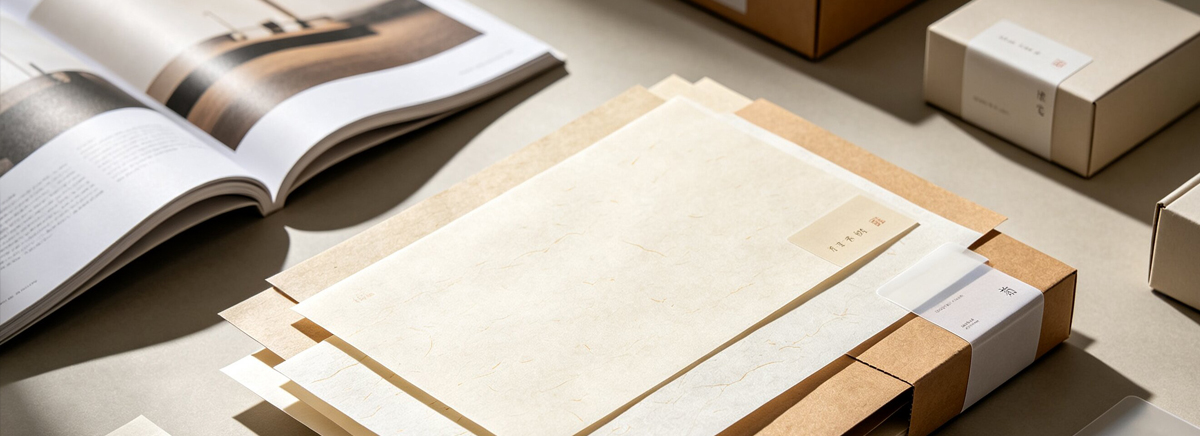
Second, we promote the commercialization and standardization of cultural value. We quantify traditional craftsmanship advantages into verifiable, comparable and internationally compliant performance indicators, transforming intangible cultural heritage into tangible, internationally recognized product strength for high-end global clients.
Third, we reshape overseas brand communication strategies. We completely phase out the low-end export model relying on low-price sales and build an exclusive brand positioning: Original Chinese Materials, Eastern Aesthetic Functional Technology. True brand premium never comes from passive price compromise, but from exclusive original value, differentiated product experience and reliable, consistent quality systems. From passive following to active cultural feedback, and from OEM manufacturing to original definition, this is the core breakthrough path for China’s packaging material industry to shake off low-end OEM limitations and achieve high-end innovative upgrading.